Microsoft 365 or Google Workspace? How We Help Teams Decide


AI Chatbots and Assistants

- 10 Nov, 2026
- 14 Views
- 0 Comment
By the LaunchLen Web Solutions Team · Last updated: November 10, 2026
Hybrid search combines classic keyword search with AI-powered semantic search, so a chatbot or search box can find the right passage when either method on its own would miss it. That matters because when an AI chatbot gives a weak answer, the problem often starts before the model writes a word. The search step picked the wrong passages.
This guide explains keyword vs semantic search in plain English, what hybrid search does, how reranking fits in and how to test whether it helps. If you’re new to chatbots that answer from your own content, start with what RAG is.
Keyword search vs semantic search
Keyword search matches the words in a question to the words in your content. A common scoring method is BM25, which ranks a passage higher when it contains the search terms, especially rarer ones. Stephen Robertson and Hugo Zaragoza explain its background in The Probabilistic Relevance Framework: BM25 and Beyond.
Keyword search is good at exact matches: product codes, part numbers, names and specific terms. It struggles when people use different words from your content. Someone asking “can I bring my dog?” might not find a page titled “Pet policy”.
Semantic search tries to match meaning instead of words. It turns text into lists of numbers called embeddings, or vectors, so passages with similar meaning sit close together. A vector database is built to search those vectors quickly.
Semantic search handles everyday phrasing well. It can miss exact terms, though, such as a model number, because it looks for “close in meaning” rather than “the same”.
In short:
- Keyword search is strong on exact words, codes and names, and weaker on synonyms and phrasing.
- Semantic search is strong on meaning and phrasing, and weaker on exact identifiers and rare terms.
What hybrid search does
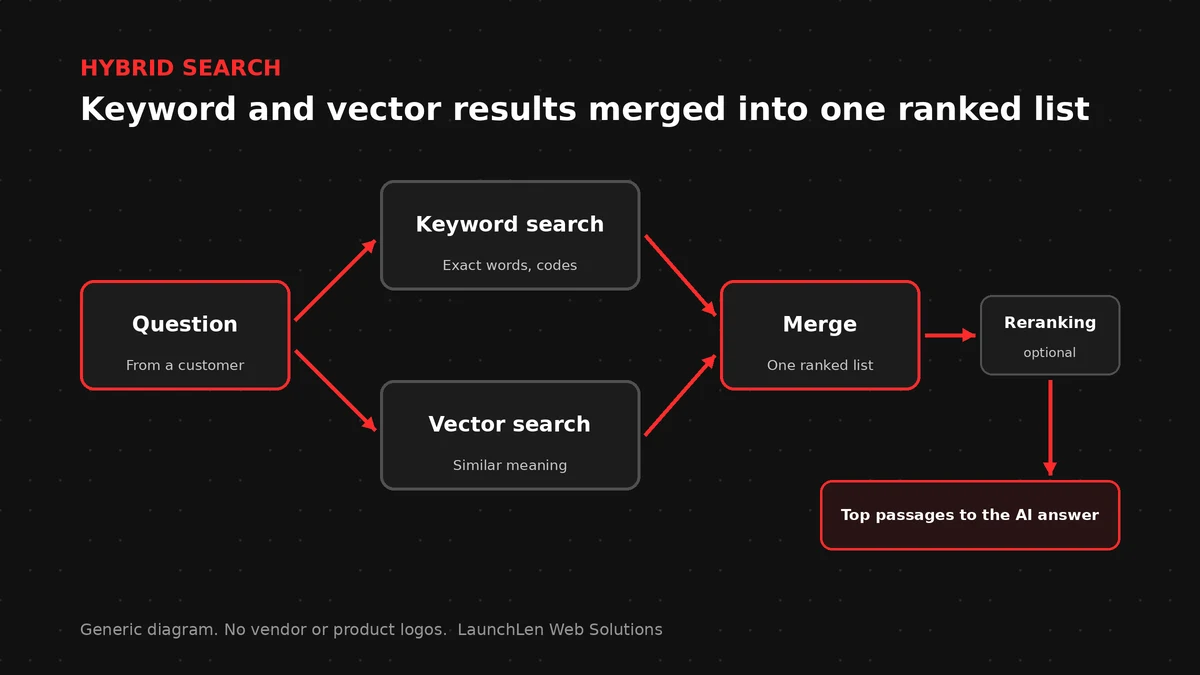
Hybrid search runs both searches on the same question, then merges the two result lists into one. OpenSearch’s documentation puts it simply: hybrid search “combines keyword and semantic search to improve search relevance.”
Merging takes some care, because each search scores results on a different scale. Two common approaches are:
- Score blending. Each list’s scores are put on a shared scale, then combined with weights you choose.
- Rank fusion. Only positions matter. Elastic’s documentation describes reciprocal rank fusion as “a method for combining multiple result sets with different relevance indicators into a single result set.”
Either way, a passage that ranks well in both lists tends to rise to the top. A passage only one method found still has a chance to appear.
That’s the reasoning behind pairing BM25 and vector search rather than picking one. In the BEIR benchmark study, researchers found that “BM25 is a robust baseline” across many kinds of search tasks. Keyword search is worth keeping when you add AI.
Reranking: picking the most useful passages
Hybrid search builds a shortlist. Reranking decides the final order.
A reranker is a model that reads the question and each candidate passage together, then scores how well the passage answers the question. It’s slower than the first search, so it usually runs on a short list rather than everything you have. An early example is the research paper Passage Re-ranking with BERT.
In a hybrid search RAG setup, the AI model reads only the top few passages. Reranking is about getting the right ones into those spots.
The trade-off is extra processing time for each question. Whether a reranker is worth it for your content is something to test, not assume.
Where it helps: chatbots, store search, internal docs
AI chatbots. A RAG chatbot searches your content before it answers. If a customer uses your exact service name, keyword matching catches it. If they phrase it their own way, semantic search catches that.
Better passages give the model a better chance of a grounded answer, which also helps reduce AI hallucinations.
Store search. Shoppers type product codes, brand names and everyday descriptions like “warm boots for kids”. Our post on ecommerce site search covers product data, filters and synonyms, which still matter with hybrid search.
Internal documents. Staff search for policy names, form titles and plain questions. An AI knowledge assistant for staff can use the same mix to find the right page.
Hybrid search won’t fix messy or outdated content. If the answer isn’t in your documents, no search method can find it.
How to test it
You don’t need to guess whether hybrid search helps. A simple test can look like this:
- Collect real questions from customers or staff. Include some with exact codes or names and some in everyday wording.
- For each question, note which passage should come back.
- Run keyword-only, vector-only and hybrid search on the same questions, and check whether the right passage appears near the top.
- Add reranking and compare again.
- Check the final AI answers, not only the search results.
Our guide to RAG evaluation explains how to judge retrieval and answers in more detail. Re-run the same questions whenever your content or settings change.
FAQ
Is hybrid search better than vector search alone?
It can be, depending on your content. It tends to help when your content mixes exact terms, like codes and names, with questions people ask in their own words. Testing with your own questions is the way to know.
Does a small business chatbot need hybrid search?
Not necessarily. For a small set of documents, one search method may be enough. Hybrid search becomes more useful as content grows or questions include product names, codes or specific terms.
What is reranking in RAG?
Reranking is a second pass that reorders the passages search found, using a model that reads the question and each passage together. It helps put the most useful passages where the AI model will read them.
Let’s work together on your project
Want your chatbot or assistant to find the right passages more often? We’re LaunchLen Web Solutions Inc.
Serving local businesses across Canada and the US, delivered remotely.
Our AI Solutions page explains how a RAG chatbot searches your approved content and pulls out the most relevant passages before it answers. For AI chatbots and assistants, we provide full technical support and ongoing updates after launch, and the service is SaaS-based, so you run the latest version.
Book a free consultation to talk it through.
DROP US A LINE
Connect with LaunchLen Web Solutions Inc.
Ready to take the first step towards unlocking opportunities, realizing goals, and embracing innovation? We're here and eager to connect.

To More Inquiry
+1 226 899 4813

To Send Mail