AI Readiness Assessment: A Checklist for Kitchener-Waterloo SMBs


AI Chatbots and Assistants

- 12 Oct, 2026
- 32 Views
- 0 Comment
By the LaunchLen Web Solutions Team · Kitchener, Ontario · Last updated: October 12, 2026
If you’ve looked into AI tools for your business, you’ve probably seen the term “RAG”. So what is RAG in AI? It stands for retrieval-augmented generation: a way of making an AI assistant answer from information you trust, such as your website, policies and documents, instead of relying only on what it learned in training.
This guide explains how RAG works, why it cuts down on made-up answers, how it differs from fine-tuning, what you need to start and where its limits are. No technical background required.
Why plain AI chatbots sometimes make things up
General-purpose AI models learn from huge amounts of text and generate answers by predicting what should come next. They’re good at writing and summarizing, but they don’t actually know your business. They’ve never seen your return policy or this season’s hours.
Ask one a question it can’t really answer and it may still give a confident, plausible-sounding reply, often called a “hallucination”. For a business, a made-up answer about a refund isn’t a quirk. It’s a customer-service problem.
What is retrieval-augmented generation, in simple terms?
RAG adds a lookup step before the AI answers. Think of it as handing a new employee the right page of your policy binder before they reply to a customer, instead of letting them guess.
The idea comes from a 2020 research paper that paired a language model with a searchable collection of documents (see Sources).
How RAG works, step by step
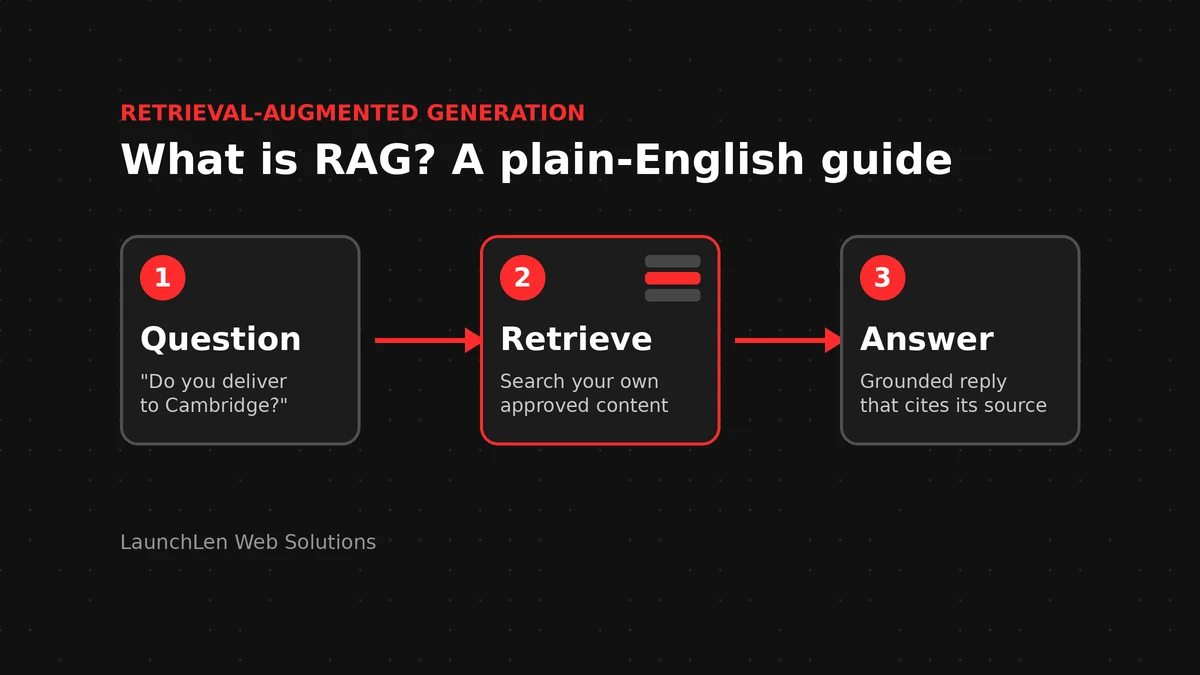
- Your content is prepared. Approved web pages, FAQs, policies or manuals are split into short passages and indexed so they can be searched by meaning, not just exact words.
- Someone asks a question. For example, “Do you deliver to Cambridge?”
- The system retrieves. It searches your indexed content and pulls out the few passages most relevant to the question.
- The AI generates an answer. The question and those passages go to the AI model with instructions like “answer using only this information.”
- The answer can point to its source. A well-built system can link to the document it used, or say “I don’t know” and pass the question to a person.
When your information changes, you update the source document. No retraining needed.
Why RAG reduces made-up answers
The AI isn’t answering from memory alone. It’s answering from text you supplied, retrieved at the moment of the question. That helps in three ways:
- Answers are grounded in your actual content rather than general internet knowledge.
- Sources can be shown, so you or your customer can check where an answer came from.
- Gaps are visible. If your content doesn’t cover something, the system can be set up to say so instead of guessing.
Security guidance from the OWASP GenAI Security Project lists RAG as one way to reduce AI misinformation, while making clear it reduces the risk rather than removing it.
RAG vs fine-tuning: what’s the difference?
People often mix these up, and vendors sometimes say “trained on your data” for both.
- Fine-tuning further trains an AI model on examples so its behaviour changes. It’s useful for a consistent style, format or specialized task. But knowledge gets baked into the model, so keeping facts current means training again, and it’s harder to see where an answer came from.
- RAG leaves the model as it is and hands it the right reference material each time it answers. It’s usually the better fit for accurate answers about information that changes, like hours, policies or product details.
The two can be combined, but if your main goal is “answer questions from our own information”, RAG is the natural place to start.
Examples: how a small business might use RAG
These are illustrations of the kind of work RAG suits, not client projects or promised results.
- A website assistant. A home-services company could let its chatbot answer routine questions about service areas and booking steps from its own pages, sending anything else to the office.
- An internal assistant for staff. A manufacturer could give its team a private assistant that answers from its procedures and safety manuals, linking to the exact document.
- A searchable policy library. A professional-services firm could let staff ask plain questions instead of opening ten PDFs.
If a customer-facing chatbot is what you have in mind, our AI Solutions page explains how we approach AI chatbots for small businesses.
What you need to get started
You don’t need a data science team. You do need:
- Clear, current content. RAG is only as good as what it reads. Outdated documents lead to outdated answers.
- A defined scope. Decide which questions the assistant handles and which always go to a person.
- An owner. Someone who keeps the source content up to date.
- A privacy check. Know what data the system will read, who can access it and where it’s stored.
- A small pilot. Start with one use case and review real answers before going wider.
If you’re earlier in the process, our practical starting guide to AI for Ontario small businesses is a good place to begin.
The limits of RAG
RAG is useful, but it isn’t magic. It can still get things wrong:
- Retrieval can miss. If the search pulls the wrong passage, the answer may be wrong but sound confident.
- The AI can still misread or over-generalize from the right passage.
- Bad content in, bad answers out. Errors in your documents get repeated.
- Documents can carry risks. Text inside a document can contain hidden instructions meant to manipulate the AI (known as prompt injection), and weak access controls can expose information to the wrong people.
That’s why human handoff, visible sources, access controls and regular review matter. Your business is still responsible for what an AI assistant tells your customers.
FAQ
Is RAG the same as ChatGPT?
No. ChatGPT is a general-purpose AI assistant. RAG is a technique that can be used with many AI models to make them answer from a specific set of documents, adding a step that looks up your content first.
Does RAG mean my data is used to train the AI model?
Not by itself. In RAG, your content is looked up and passed to the model with each question, not used to retrain it. Whether an AI provider keeps or uses that data depends on its terms and settings, so check them before connecting business information.
Can RAG completely stop AI from making things up?
No. It reduces made-up answers but doesn’t eliminate them. Good systems pair RAG with source links, a clear “I don’t know” response and handoff to a person.
Let’s work together on your project
Curious whether RAG fits the way your business works? We’re LaunchLen, an IT services team based in Kitchener, serving Waterloo Region and businesses across Ontario. We’re happy to talk through your goals and whether an AI assistant makes sense at all. Book a free consultation to start the conversation.
Sources
- Lewis et al., “Retrieval-Augmented Generation for Knowledge-Intensive NLP Tasks” (2020): https://arxiv.org/abs/2005.11401
- IBM Research, What is retrieval-augmented generation?: https://research.ibm.com/blog/retrieval-augmented-generation-RAG
- AWS, What is RAG?: https://aws.amazon.com/what-is/retrieval-augmented-generation/
- OWASP GenAI Security Project, LLM09:2025 Misinformation: https://genai.owasp.org/llmrisk/llm092025-misinformation/
- OWASP GenAI Security Project, LLM01:2025 Prompt Injection: https://genai.owasp.org/llmrisk/llm01-prompt-injection/

DROP US A LINE
Connect with LaunchLen Web Solutions Inc.
Ready to take the first step towards unlocking opportunities, realizing goals, and embracing innovation? We're here and eager to connect.

To More Inquiry
+1 226 899 4813

To Send Mail