WordPress + AI: Plugins, Chatbots and Safe Integrations for Business Sites


Cloud, Hosting and Security


- 11 Oct, 2026
- 58 Views
- 0 Comment
By the LaunchLen Web Solutions Team · Kitchener, Ontario · Last updated: October 11, 2026
“Is our data stored in Canada?” is one of the first questions business owners ask when they move to the cloud or start using AI tools. It’s a good question. It’s just not the whole question. Where data sits, who can reach it, which laws apply to it and where it goes while it’s being processed are four different things, and vendor marketing often blurs them together.
This guide explains what data residency means, which Canadian cloud regions the major providers list, the basic PIPEDA point about sending data to service providers, and the questions worth asking before you sign up for any cloud or AI service.
Not legal advice. This article is general information only. It is not legal advice and doesn’t create a lawyer-client relationship. Privacy and data-residency rules depend on your province, industry, customers and the data you handle, and they change. Before you make decisions about where your data is stored or processed, get advice from a qualified privacy lawyer.
What data residency means (and what it doesn’t guarantee)
Data residency is the physical or geographic location where your data is stored. If your provider stores your files in a data centre in Toronto or Montréal, that data resides in Canada.
Federal guidance written for the Government of Canada’s own systems also separates residency from data sovereignty, meaning whose laws can reach the data. That guidance notes that data stored with a cloud provider may be subject to the laws of other countries regardless of where it physically sits, and that storing data in Canada does not by itself guarantee it is outside the reach of foreign courts. It’s written for government, not small businesses, but the distinction is a useful one to keep in mind.
So “stored in Canada” can be valuable. It may help you meet a contract term or a customer’s expectations. But it doesn’t, by itself, guarantee:
- that every copy (backups, logs, replicas) stays in Canada;
- that data processed by a service, such as an AI model answering a prompt, is handled in Canada;
- that support staff in other countries can’t access it;
- that foreign laws can never reach it.
Canadian cloud regions from major providers
The largest cloud providers publish lists of their regions, and each lists Canadian locations. As of this writing:
- Amazon Web Services (AWS) lists two Canadian regions: Canada (Central) and Canada West (Calgary).
- Microsoft Azure lists Canada Central (Toronto) and Canada East (Quebec), and shows them as each other’s paired region.
- Google Cloud lists regions in Montréal and Toronto.
Region lists change, and not every service a provider offers is available in every region. Check each provider’s current documentation (linked in the sources below) for the specific services you plan to use.
A region existing isn’t the same as your data being in it. You, or whoever set up your account, usually choose the region when creating each resource. Some services are “global” by design and don’t let you pick a location at all.
PIPEDA basics for AI tools and cloud vendors
Most private-sector businesses in Ontario that collect, use or disclose customers’ personal information in the course of commercial activities are covered by the federal Personal Information Protection and Electronic Documents Act (PIPEDA). Health-sector organizations in Ontario may have additional obligations under the Personal Health Information Protection Act (PHIPA); get advice on what applies to you.
On sending personal information to service providers, the Office of the Privacy Commissioner of Canada (OPC) puts the starting point this way: “PIPEDA does not prohibit organizations in Canada from transferring personal information to an organization in another jurisdiction for processing. However, under PIPEDA, organizations are held accountable for the protection of personal information transfers under each individual outsourcing arrangement.”
The OPC’s principles for generative AI apply similar thinking to AI tools: limit personal information to what’s needed, be open about how AI is used, and stay accountable for the outcomes.
If you serve customers in Quebec, or transfer personal information outside Canada, the rules can be complex and are still evolving. Get advice from a qualified privacy lawyer. Useful starting points are the OPC’s guidelines for processing personal data across borders and the Commission d’accès à l’information du Québec’s guidance on communicating personal information outside Quebec (in French).
Questions to ask any AI or SaaS vendor
Before you sign up for a cloud service, AI tool or software-as-a-service (SaaS) app that will handle customer or employee information, get clear answers to these:
- Where is our data stored? Ask for the countries or regions, and whether you can choose.
- Where is it processed? For AI tools especially, ask where prompts and responses are handled, which can differ from where data is stored.
- Where do backups, logs and replicas go?
- Who can access it, and from where? That includes the vendor’s support and engineering staff and any subcontractors.
- Which subprocessors do you use? Ask for the list and how you’ll be told about changes.
- Is our data used to train or improve your models? Can we opt out, and is that the default for business accounts?
- How long is data kept, and how do we delete it? What happens to it if we cancel?
- How do you respond to government or law-enforcement requests? Will you notify us where the law allows?
- Is data encrypted in transit and at rest? Who holds the keys?
- What does the contract actually say? Marketing pages aren’t commitments. The terms, data processing agreement and privacy policy are what count.
Write the answers down. They help with your own privacy notice, and you’ll be glad to have them the next time a customer asks.
Deciding what needs to stay in Canada
For many small businesses, the practical decisions break down into three layers:
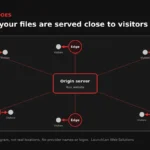
- Your website. A typical marketing website holds little personal information beyond contact-form submissions. Where those submissions are stored and emailed matters more than where the page files are served from. Many sites also use a content delivery network, which by design serves copies of public pages from locations around the world.
- Your business systems. Email, file storage, accounting, CRM and booking tools often hold the most sensitive information. Each vendor makes its own residency choices, so check them one by one.
- Your AI tools. These add the processing question. Even when a provider lets you choose a Canadian region, the deployment option you pick can determine where prompts are processed (see the FAQ below).
Not every business needs Canadian residency for everything. A risk-based approach works better: identify which data is sensitive, which contracts or customers require Canadian storage, and focus your effort there.
LaunchLen Web Solutions Inc. is a web and AI development team. Based in Kitchener, serving Waterloo Region and businesses across Ontario. You can read more about our cloud and hosting, AI solutions and IT consulting services. For a broader look at AI and privacy for Ontario businesses, see our guide to AI for small business in Ontario.
FAQ
Does PIPEDA require Canadian hosting?
No, PIPEDA doesn’t require it. In the OPC’s words, “PIPEDA does not prohibit organizations in Canada from transferring personal information to an organization in another jurisdiction for processing,” but your business remains accountable for that information. Contracts, your sector, provincial laws or your customers may set stricter requirements, so get advice from a qualified privacy lawyer on what applies to you.
Is my data in Canada if my vendor has a Canadian region?
Not necessarily. A vendor having a Canadian region doesn’t mean your account or every service you use is set to it. Backups, logs, support access and AI processing can also happen elsewhere. Ask the vendor where your specific data is stored and processed, and get it in writing.
Can AI models run on Canadian infrastructure?
Sometimes. Major cloud providers publish which AI models are available in which regions, and the lists change often. Pay attention to deployment options: Microsoft’s documentation says “Global” deployment types may process inference data in any Azure region, AWS’s cross-Region inference can route requests to other regions within a geography such as the US or EU (geographic) or to regions worldwide (global), so a model called from a Canadian region isn’t necessarily processed in Canada, and Google notes that its AI endpoints don’t by themselves guarantee data residency or in-region processing. Check the specific model, region and deployment type.
What about backups?
Backups are where residency quietly breaks most often. Check where backup and disaster-recovery copies are stored, since some setups replicate data to a second region automatically. Azure, for example, pairs Canada Central with Canada East, but on other services or providers the default or chosen backup location could be outside Canada. Also check how long backups are kept, and test that you can restore them.
Questions about where your data lives?
Not sure where your website, business tools and AI services actually keep your data? Let’s talk it through.
[Book a free consultation] → https://launchlenwebsolutions.ca/contact/
Call +1 226 899 4813 or email info@launchlenwebsolutions.ca.
LaunchLen Web Solutions Inc., Kitchener, Ontario.
Not legal advice. This article is general information only and is not legal advice. It doesn’t cover every law that may apply to your business, including provincial and sector-specific rules. Laws, provider regions and service terms change, so check the official sources below and get advice from a qualified privacy lawyer before acting on anything here.
Sources
- Government of Canada, Digital Sovereignty: A Framework to improve digital readiness of the Government of Canada (written for federal operations): https://www.canada.ca/en/government/system/digital-government/digital-government-innovations/cloud-services/digital-sovereignty/digital-sovereignty-framework-improve-digital-readiness.html
- AWS documentation, AWS Regions (Canada (Central), Canada West (Calgary)), accessed Oct 11, 2026: https://docs.aws.amazon.com/global-infrastructure/latest/regions/aws-regions.html
- Microsoft Learn, Azure regions list (Canada Central, Toronto; Canada East, Quebec; paired regions), accessed Oct 11, 2026: https://learn.microsoft.com/en-us/azure/reliability/regions-list
- Google Cloud, Regions and zones (Montréal, Toronto), accessed Oct 11, 2026: https://cloud.google.com/compute/docs/regions-zones
- Office of the Privacy Commissioner of Canada, Guidelines for processing personal data across borders (2009): https://www.priv.gc.ca/en/privacy-topics/airports-and-borders/gl_dab_090127/
- Commission d’accès à l’information du Québec, Principaux changements de la Loi 25 (in French): https://www.cai.gouv.qc.ca/protection-renseignements-personnels/sujets-et-domaines-dinteret/principaux-changements-loi-25
- Office of the Privacy Commissioner of Canada, PIPEDA in brief: https://www.priv.gc.ca/en/privacy-topics/privacy-laws-in-canada/the-personal-information-protection-and-electronic-documents-act-pipeda/pipeda_brief/
- Office of the Privacy Commissioner of Canada, Principles for responsible, trustworthy and privacy-protective generative AI technologies: https://www.priv.gc.ca/en/privacy-topics/technology/artificial-intelligence/gd_principles_ai/
- Government of Ontario, Personal Health Information Protection Act, 2004 (pointer only): https://www.ontario.ca/laws/statute/04p03
- Microsoft Learn, Deployment types for Microsoft Foundry Models (Global types may process data in any Azure region): https://learn.microsoft.com/en-us/azure/ai-foundry/foundry-models/concepts/deployment-types
- AWS documentation, Amazon Bedrock cross-Region inference (geographic vs global): https://docs.aws.amazon.com/bedrock/latest/userguide/cross-region-inference.html
- Google Cloud, Generative AI locations (endpoints don’t guarantee data residency or in-region processing): https://cloud.google.com/vertex-ai/generative-ai/docs/learn/locations
DROP US A LINE
Connect with LaunchLen Web Solutions Inc.
Ready to take the first step towards unlocking opportunities, realizing goals, and embracing innovation? We're here and eager to connect.

To More Inquiry
+1 226 899 4813

To Send Mail