Launching on Shopify: How We Set Up Your Store With You


AI Automation and Agents

- 7 Nov, 2026
- 18 Views
- 0 Comment
By the LaunchLen Web Solutions Team · Kitchener, Ontario · Last updated: November 7, 2026
A multi-agent system uses several AI agents that each handle part of a task: one might plan, another research, another check the result.
That split can help with big or varied jobs, but it also adds moving parts, cost and new ways to fail.
This guide explains what multi-agent systems are, common patterns, when a single agent is the better choice, and where people should stay in the loop.
What multi-agent systems are
An AI agent is a model that can take steps toward a goal: call tools, read results and decide what to do next. Our guide to agentic AI workflows covers the single-agent basics.
A multi-agent system connects several of those agents. Each one usually has:
- Its own instructions and role.
- Its own set of tools.
- A defined way to pass work to the next agent or back to a coordinator.
The agents might use the same model or different ones. What makes it “multi-agent” is the division of work, not the number of models.
Common patterns: manager-worker, pipeline, reviewer
Most designs are variations on a few patterns.
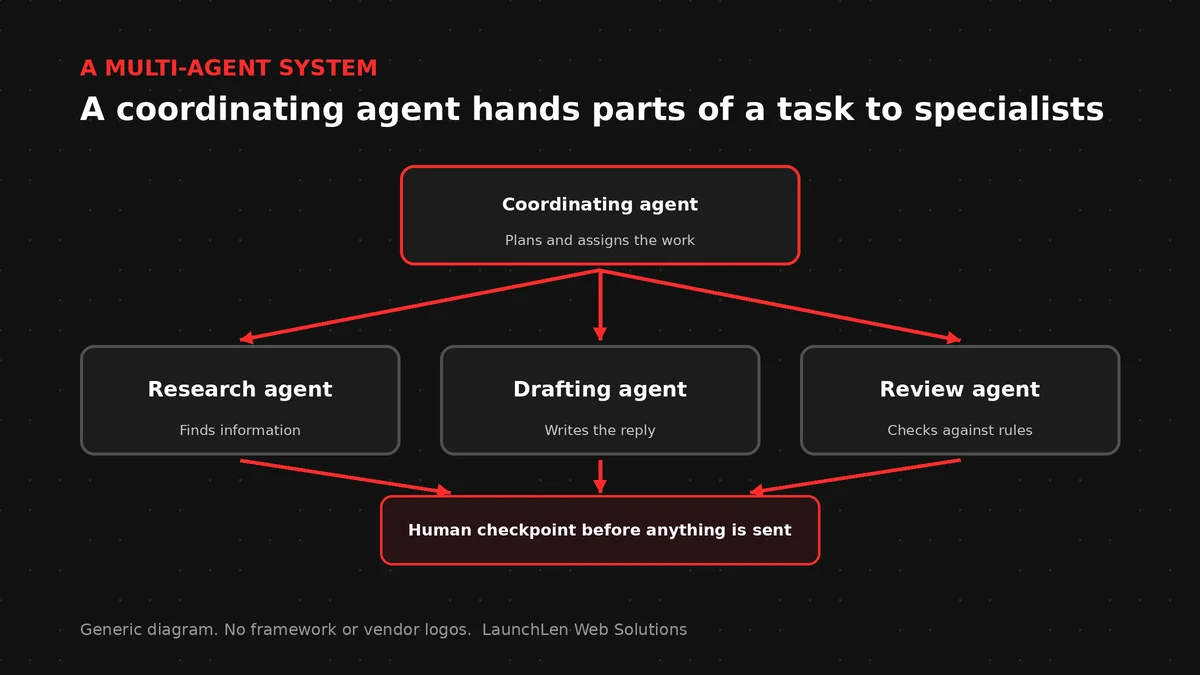
Manager-worker. A coordinating agent breaks a task into pieces and hands them to specialist agents. It then combines the results.
Pipeline. Agents work in a fixed order. One extracts details from a document, the next drafts a summary, the next formats it for your system.
Reviewer. One agent produces work and another checks it against rules or a rubric. The reviewer can send it back for another pass.
These can be combined. A manager can hand tasks to workers whose output then goes through a reviewer.
One model provider’s engineering write-up on its research system describes a lead agent that plans and spins up sub-agents to explore in parallel. It also notes the extra cost that comes with that approach.
When one agent is simpler and better
Many business tasks don’t need more than one agent, and sometimes they don’t need an agent at all.
A single agent, or a fixed workflow with a model call in it, can be the right fit when:
- The task follows the same steps most of the time.
- One set of tools covers the job.
- You need predictable cost and easy debugging.
Provider guidance on building agents makes a similar point. It suggests starting with the simplest solution and adding complexity only when it clearly helps.
Multi-agent designs can make more sense when the task is broad, parts can run in parallel, or different parts need very different tools and instructions.
If you’re weighing libraries for either approach, our overview of AI agent frameworks compares the options in general terms.
Coordination, cost of complexity and errors
Every extra agent adds handoffs between agents, and each handoff is a place where context can get lost.
Common problems include:
- Lost context. A worker agent misses a constraint the coordinator knew about.
- Duplicated work. Two agents research the same thing.
- Error chains. One agent’s mistake becomes the next agent’s “fact.”
- Runaway loops. Agents keep passing work back and forth without finishing.
- Higher cost and latency. More model calls mean more spend and more waiting.
Practical controls can include clear roles, structured messages between agents, step and budget limits, and logs that show which agent did what.
OWASP’s guidance on excessive agency also applies. Too much functionality, too many permissions or too much autonomy can turn a model error into a real-world action. Give each agent only the tools its role needs.
Human checkpoints across agents
More agents doesn’t mean less oversight. If anything, it means you need clear checkpoints.
Checkpoints can include:
- Approval before any agent sends a message, changes a record or spends money.
- Review of the final output before it reaches a customer.
- Spot checks of intermediate steps during early rollout.
For customer-facing chatbots, a handoff to people works the same way regardless of how many agents sit behind it. The main path is the bottom-right website widget, and unresolved questions can create a ticket that a specialist escalates and handles.
The NIST AI Risk Management Framework is a useful reference for thinking about oversight and accountability across a system, not just a single model.
FAQ
Are multi-agent systems more accurate than one agent?
Not automatically. A reviewer agent can catch some mistakes, but extra agents can also add new ones. Test against your own tasks before assuming a gain.
Do multi-agent systems cost more to run?
Usually, because they make more model calls. Whether that’s worth it depends on the value of the task and whether a simpler design would do.
Can I start with one agent and add more later?
Yes. Starting simple makes it easier to see where a second agent would actually help. Keep tools and prompts modular so you can split roles later.
Let’s work together on your project
Not sure whether your workflow needs one agent, several or none? We’re LaunchLen Web Solutions Inc.
Based in Kitchener, serving Waterloo Region and businesses across Ontario.
Our AI Solutions page covers AI chatbots for small business, trained on your own content, and the other AI tools we build with the same approach: start small and widen the scope only after a pilot earns it. Before any build, we can agree the scope, deliverables and reporting with you. Book a free consultation to get started.

DROP US A LINE
Connect with LaunchLen Web Solutions Inc.
Ready to take the first step towards unlocking opportunities, realizing goals, and embracing innovation? We're here and eager to connect.

To More Inquiry
+1 226 899 4813

To Send Mail