Fewer Abandoned Carts: How We Review Your Ecommerce Checkout


AI Automation and Agents

- 11 Nov, 2026
- 11 Views
- 0 Comment
By the LaunchLen Web Solutions Team · Last updated: November 11, 2026
If your business already runs RPA bots, spreadsheet macros or rule-based workflows, you’ve probably heard that agentic AI is the next step. Moving from RPA to agentic AI doesn’t mean throwing out what works.
In most cases it means keeping the reliable rules and adding AI only where a step needs reading or judgement. This guide is for teams that already automate something. If you’re still choosing between approaches, start with our comparison of AI process automation vs RPA vs agentic AI.
RPA to agentic AI: what actually changes
RPA (robotic process automation) follows fixed steps: click here, copy this field, paste it there. It’s fast and predictable when the input looks the same every time.
It struggles when a screen changes, a form arrives in a new layout or a case doesn’t fit the rules. Those cases usually end up in an exceptions queue for a person.
An agentic AI system works toward a goal instead of a fixed script. It can read unstructured input, decide the next step within limits you set and ask to use approved tools. Our guide to agentic AI workflows explains the idea with examples.
The big shift is from “do exactly these steps” to “work out the next step within these limits.” That brings flexibility. It also means outputs can vary, so checks matter more than they did with fixed rules.
What to keep: the rules that already work
Rule-based steps are usually cheaper to run and easier to test than AI steps. Keep them where they do the job:
- Steps with clear, stable inputs, such as moving data between two systems with fixed fields.
- Scheduled jobs and routine reports.
- Anything where the answer must be the same every time, like calculations or applying a price list.
- Approval steps and audit trails your team already relies on.
Replacing a working rule with a model rarely makes sense. If a macro or bot has run quietly for years, leave it alone.
What to change: where AI judgement helps
AI earns its place on the steps that rules handle badly:
- Reading messy input: emails, PDFs, scanned forms and free-text notes.
- Handling exceptions that currently land in a “bot failed” queue.
- Sorting and routing requests by topic and urgency.
- Drafting a reply or a record for a person to check.
A useful test is your exceptions log. Where your bots stop and a person takes over, there’s often a judgement step that AI could help with.
Excel macros and RPA bots: a hybrid approach
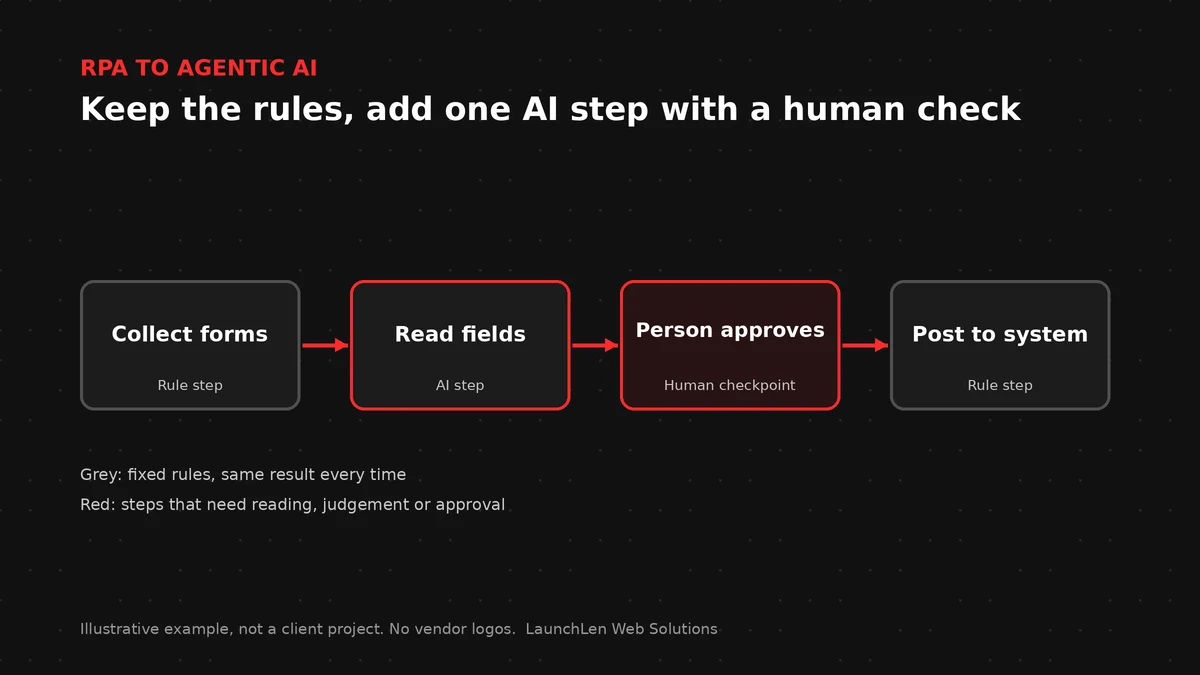
Many teams end up with a hybrid. Rules do the predictable steps, an AI step handles the part that needs reading or judgement, and then rules take over again.
Here’s an illustrative example, not a client project. A rule-based job collects new intake forms. An AI step pulls the key fields from forms in different layouts. A person approves the draft entry, and the existing bot posts it to the business system.
In a setup like this, the model requests actions and your code decides whether to run them. Our post on LLM function calling covers that pattern. When several AI roles pass work to each other, you’re into multi-agent systems, but it’s usually wiser to start with one AI step.
Guardrails to add before you hand over steps
Before an AI step takes over work a bot or person used to do, plan these controls:
- Limited permissions. The AI step gets access only to the tools and data it needs.
- Human approval. A person approves anything that sends, pays, deletes or changes records.
- Logging. Record what the AI step saw, decided and did, so your team can review it.
- A clear fallback. Unusual input or a low-confidence result goes to a person.
- Testing. Run real examples before each change goes live.
NIST’s AI Risk Management Framework is a useful general reference for thinking about AI risks across a project’s life, and its AI RMF Playbook suggests practical actions.
A simple plan for your first step
You don’t need to move everything at once. A first step can look like this:
- Pick one process with a clear owner and a visible exceptions queue.
- Map the steps and mark which are rules and which need judgement.
- Keep the rules, and design one AI step with an approval checkpoint.
- Run a pilot alongside the current process and compare the results.
- Widen the scope only when the pilot earns it.
FAQ
Do we have to replace our RPA bots to use agentic AI?
No. Many businesses keep their bots for stable, rule-based steps and add AI only for the steps that need reading or judgement.
Can agentic AI work with Excel macros and older systems?
Often, through the same files, APIs or screens your current automation already uses. Where a system has no usable connection, it may need custom integration work, which would be scoped first.
Is agentic AI less predictable than RPA?
Its outputs can vary more, which is why approval steps, limited permissions, logging and testing matter. Keep fixed rules wherever the answer must be the same every time.
Let’s work together on your project
Planning a move from RPA or macros to agentic AI? We’re LaunchLen Web Solutions Inc.
Serving local businesses across Canada and the US, delivered remotely.
Our AI Solutions page lists the AI work we do beyond the website chatbot, including document and invoice processing, email and ticket triage, and agentic workflow automation. These are project builds: a build can include human checkpoints, limited permissions and action logging, and post-launch support can be agreed per project. Full technical support and ongoing SaaS updates apply to our AI chatbots and assistants.
Before any build, we can agree the scope and deliverables with you. Book a free consultation to get started.
DROP US A LINE
Connect with LaunchLen Web Solutions Inc.
Ready to take the first step towards unlocking opportunities, realizing goals, and embracing innovation? We're here and eager to connect.

To More Inquiry
+1 226 899 4813

To Send Mail