SQL vs NoSQL: Choosing a Database for Your Web App


SEO and Growth Marketing

- 21 Nov, 2026
- 5 Views
- 0 Comment
By the LaunchLen Web Solutions Team · Last updated: November 21, 2026
A business blog can start with energy and stall a few months later. Posts get written because a topic seemed popular, several pages end up chasing the same search term, and nobody can say which posts brought in an enquiry.
An SEO content strategy fixes that by deciding what to publish, and why, before anyone writes. This post explains how we plan one with you, from customer questions to a content calendar your team can follow.
What an SEO content strategy is (and isn’t)
An SEO content strategy is a plan that connects what your customers search for with the pages on your site that answer them. It covers which topics to write about, which page answers each one and in what order to publish.
Our SEO Services page describes this work as service pages that say clearly what you do and where you do it, FAQ sections built from real customer questions, and a content plan tied to what your customers search for.
It isn’t a promise of rankings, and it isn’t publishing as much as possible. Google’s guidance on helpful, reliable, people-first content says its ranking systems are designed to prioritize information “created to benefit people, and not content that’s created to manipulate search engine rankings.”
Starting with the questions your customers ask
The strongest content ideas tend to come from your own business, not from a list of trending topics. Before planning, we gather questions from the places customers already ask them:
- Emails and enquiry forms. The questions people ask before they buy.
- Your team. What staff explain over and over.
- Search data. What people type into search, which our post on keyword research for local businesses covers in detail.
Google’s guidance suggests asking yourself whether you have “an existing or intended audience for your business or site that would find the content useful if they came directly to you”. If a topic wouldn’t help a real customer, it doesn’t go in the plan.
Mapping topics to pages: one topic, one page
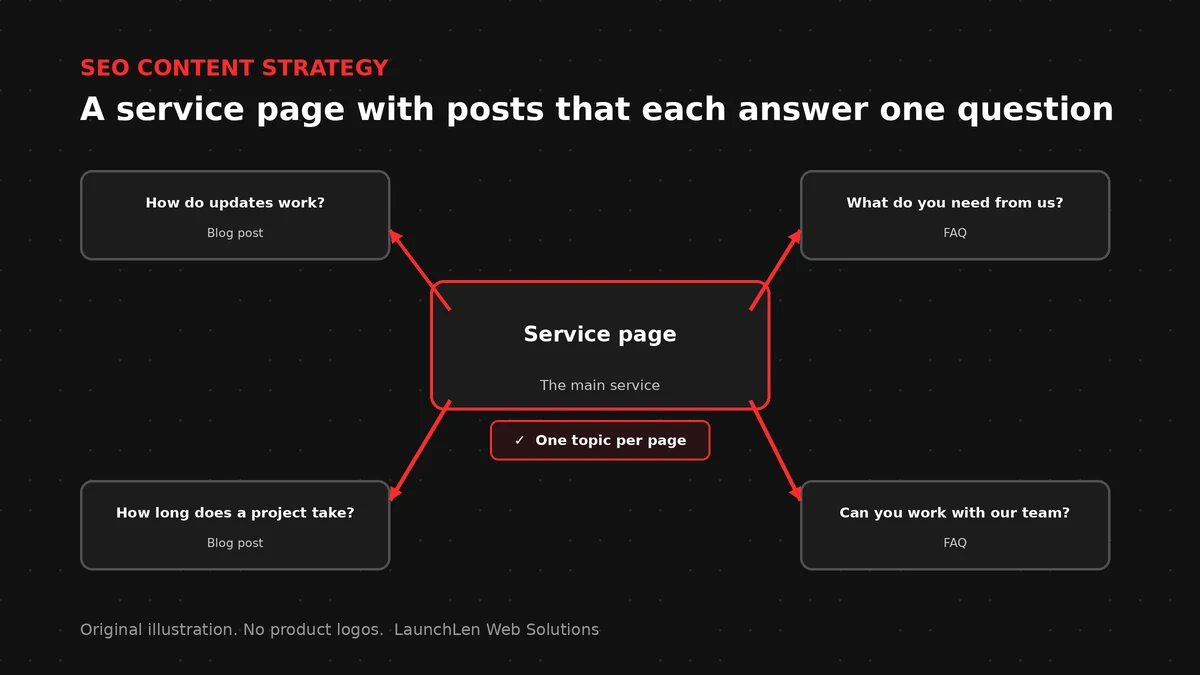
Next, each question gets a home. Some belong on a service page or its FAQ, and others deserve their own post that links back to the service page.
This creates topic clusters: a main page for each service, supported by posts that answer related questions in more depth. Our post on how we structure service pages explains the main-page side.
The key rule is one main topic per page. When several pages on one site target the same search term, the problem is known as keyword cannibalization: the pages compete for the same searches instead of each doing its own job. Google’s SEO Starter Guide notes that showing the same content under different URLs “can be a bad user experience”, so we check every new idea against what’s already published.
Building the content plan for SEO
With the map in place, we turn it into a content plan you can act on. The plan is written in plain language, so anyone on your team can see what’s coming next and why it was chosen. A plan can include:
- A priority order. Topics closest to what you sell, and most likely to help a customer decide, come first.
- A brief for each piece. The question it answers, the main search term, the page it supports and the links it should include.
- A realistic schedule. One your team can keep up with, rather than a burst followed by silence.
AI tools can help with research and drafts. A person who knows your business decides what gets published, and our process can include human editing and fact-checking before anything goes live.
Reviewing what works and updating it
A content plan isn’t fixed. Once pages are published, we look at how they’re doing using data you can check yourself, such as impressions, clicks and search queries in Google Search Console. Our post on how we report on SEO explains what we measure and why.
That review shapes the next round:
- Pages that get seen but rarely clicked may need a clearer title or description.
- Posts that drift out of date get refreshed rather than replaced.
- New customer questions get added to the map.
We also look at which pages lead to enquiries, where your tracking allows. A post that brings steady visits but no enquiries may need a clearer link to the matching service page, while a page that converts well may deserve more supporting posts around it.
FAQ
How is a content strategy different from keyword research?
Keyword research finds what people search for. A content strategy decides which page answers each search, in what order to publish and how the pages link together.
Does AI-generated content hurt SEO?
Google’s post on AI-generated content in Search says its systems aim to reward high-quality content “however it is produced”, and that using automation, including AI, mainly to manipulate rankings violates its spam policies. That’s why a person reviews everything before it’s published.
How soon will we see results?
It varies with your site’s current condition, your competition and how much work is done. Content tends to build over time, so we set expectations after looking at your site.
Working with LaunchLen
We’re LaunchLen Web Solutions Inc. Our SEO Services page covers on-page and content strategy alongside technical SEO and reporting.
A content strategy project can include gathering customer questions, mapping topics to pages, writing briefs and setting a publishing schedule. What we won’t do is promise a ranking. The scope is agreed with you before work starts.
Serving local businesses across Canada and the US, delivered remotely.
DROP US A LINE
Connect with LaunchLen Web Solutions Inc.
Ready to take the first step towards unlocking opportunities, realizing goals, and embracing innovation? We're here and eager to connect.

To More Inquiry
+1 226 899 4813

To Send Mail