Multi-Agent Systems: When One AI Agent Isn’t Enough


SEO and Growth Marketing

- 8 Nov, 2026
- 11 Views
- 0 Comment
By LaunchLen Web Solutions Team
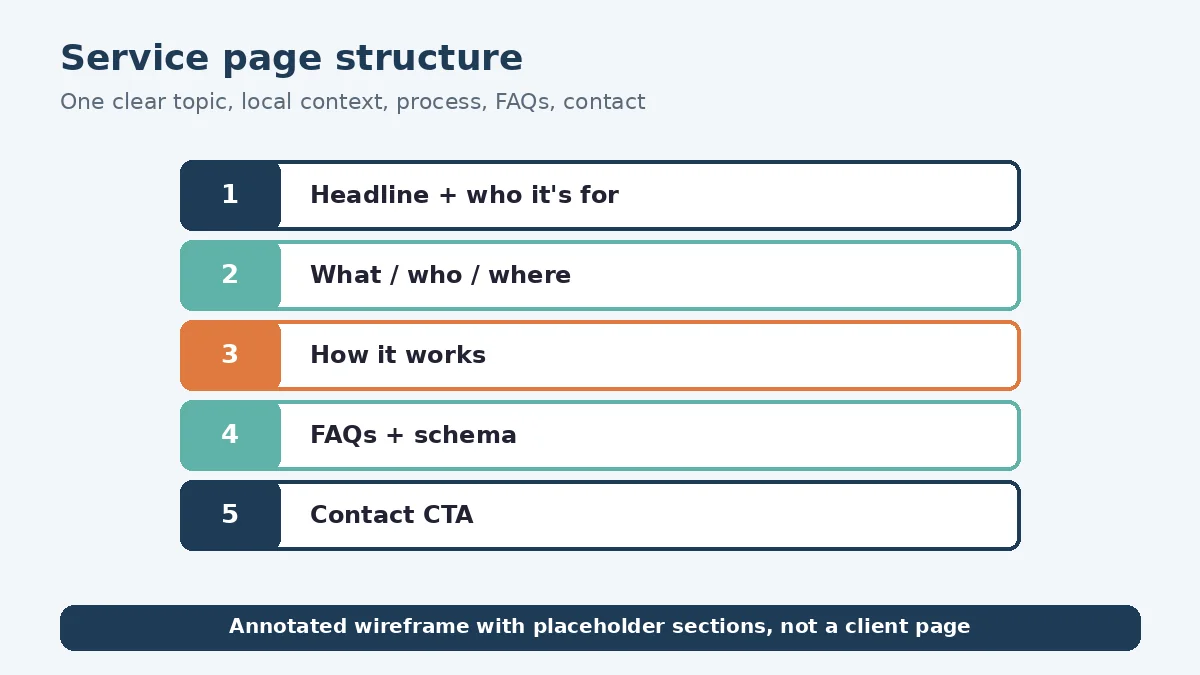
For many local businesses, service pages do the heavy lifting. They’re where a visitor decides whether you do what they need, in the area they’re in. They’re also what search engines and AI assistants read when deciding which business to show or mention.
Service page SEO isn’t about tricks. It’s about pages that answer a customer’s questions clearly, in a structure machines can follow. This post explains how LaunchLen Web Solutions Inc. can plan and structure service pages for SEO, using our own pages as examples. We don’t offer a general copywriting service; this is SEO structure and planning work.
Service page SEO: one service, one page, one keyword
A service page can work well when it’s about one thing. If a single page tries to cover web design, hosting and SEO, it can end up vague for visitors and unclear for search engines.
Planning can start with:
- One service per page, such as AI chatbots, WordPress development or cloud hosting.
- One primary keyword that matches how customers describe the service, chosen through keyword research.
- A clear URL, such as /service/seo-services/.
- No overlap. Two pages targeting the same phrase can compete with each other.
Our post on local keyword research explains how the primary keyword for each page can be chosen and mapped.
Google’s guidance on helpful content asks whether “the main heading or page title” provides “a descriptive, helpful summary of the content” and whether it avoids “exaggerating or being shocking in nature” (Google Search Central, Creating helpful, reliable, people-first content). A service page heading can do both by naming the service and the area plainly.
Above the fold: what, who, where
The top of the page can answer three questions before a visitor scrolls:
- What you offer, in plain words.
- Who it’s for, such as small businesses, retailers or professional firms.
- Where you work, if location matters to your customers.
Our own pages follow this pattern. The SEO services page opens with the heading “SEO & AI Search Optimization for Kitchener-Waterloo Businesses,” then explains in its first paragraph where customers find local businesses today. Our SEO, cloud and AI solutions pages use the same service-area line, so the location is stated consistently.
A clear next step can sit near the top too, such as a consultation link, so visitors who are ready don’t have to hunt for it.
Proof without hype: process, not invented stats
Visitors want to know whether they can trust you. The temptation is to fill a page with big numbers and glowing quotes. Invented statistics or testimonials damage trust, and they can mislead customers.
Honest proof can include:
- How the work happens, step by step.
- What’s included, and what isn’t.
- Honest limits, such as what a service can’t promise.
- Clear authorship and business details, so visitors know who’s behind the page.
Google’s guidance says that “of these aspects, trust is most important” when describing experience, expertise, authoritativeness and trustworthiness, and it warns against deceptive authorship, such as “made-up names, or false credentials” (Google Search Central). Our SEO services page, for example, states plainly: “What we won’t do is promise a ranking.”
FAQs that answer real questions
FAQ sections are more useful when they answer questions customers actually ask. Good sources can include sales enquiries, support emails, questions asked at the first consultation and the search terms people use.
Answers can be short and direct, with the key point in the first sentence. Questions about cost, timing or ownership can be answered honestly even when the answer is “it depends,” as long as the page explains what it depends on.
Our SEO services page FAQ is one example. It answers the question about first-page rankings with a plain “No.” and explains why: search engines control rankings and change their systems regularly. An honest answer like that can build more trust than a vague one.
Schema and internal links
Structured data describes a page in a machine-readable way. On a service page, schema can describe the organization, the service and the FAQs, using types such as Organization, Service or FAQPage where they fit the content. As of May 2026, Google no longer shows FAQ rich results in Search, so FAQPage markup can describe visible FAQs but does not earn a special FAQ display in Google. Google’s guidance on AI features lists “making sure your structured data matches the visible text on the page” among the SEO fundamentals that remain worthwhile (Google Search Central, AI features and your website).
The same page is clear that “there are no additional requirements to appear in AI Overviews or AI Mode,” and that there’s “no special schema.org structured data that you need to add.” That’s why the work that helps AI answers is mostly the same work that helps search: clear text, crawlable pages and accurate business details. Our guide to GEO and AI Overviews for local businesses covers this in more depth, and our guide to adding schema markup to WordPress shows how structured data can be added.
Internal links help too. Google lists “making your content easily findable through internal links on your website” among its best practices (Google Search Central). A service page can link to related services and helpful blog posts, and blog posts can link back to the service page.
Tracking and reporting are your choice: Google Analytics or any tool or platform you prefer, on a schedule agreed with you.
Here’s an illustrative example (not a real client): a landscaping company has one page listing every service. Splitting it into separate pages for design, installation and seasonal care gives each one a clear heading, its own FAQs and links between them.
FAQ
How long should a service page be?
Long enough to answer the questions a customer has about that service. Google says it has no preferred word count, so the focus can be on completeness and clarity rather than a target length.
Do I need separate pages for each location?
Not necessarily. A single page can state your service area clearly. Separate location pages can make sense when the service or details differ by area, as long as each page offers useful, distinct content.
Who owns the service page work you deliver?
How you can use the page plans and SEO recommendations we deliver, including with your own team or another provider, can be agreed with you before the project starts.
Working with LaunchLen
We’re LaunchLen Web Solutions Inc. Based in Kitchener, serving Waterloo Region and businesses across Ontario.

DROP US A LINE
Connect with LaunchLen Web Solutions Inc.
Ready to take the first step towards unlocking opportunities, realizing goals, and embracing innovation? We're here and eager to connect.

To More Inquiry
+1 226 899 4813

To Send Mail