What Is a Webhook? How Apps Talk to Each Other in Real Time


Web Design and Development

- 4 Nov, 2026
- 3 Views
- 0 Comment
By LaunchLen Web Solutions Team
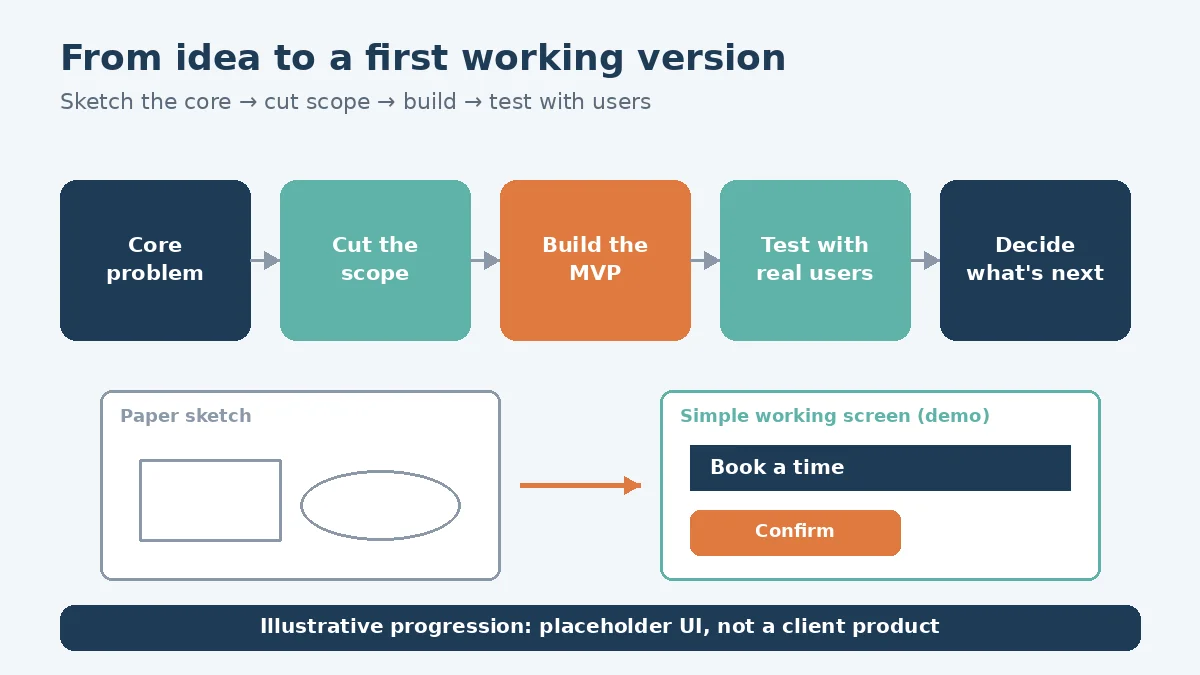
Many software ideas start big. A customer portal that also handles quotes, invoices, scheduling and reporting. A tool that replaces every spreadsheet in the office at once. It’s natural to want the whole thing.
MVP development takes a different route: build the smallest version that solves one real problem, put it in front of real users and let what they do shape what comes next. This post explains how LaunchLen Web Solutions Inc. can approach a minimum viable product with you, from choosing the problem to planning version two.
What an MVP is (and isn’t)
The term was popularized by the Lean Startup method. Its methodology page describes a “build-measure-learn feedback loop” in which the first step is “figuring out the problem that needs to be solved and then developing a minimum viable product (MVP) to begin the process of learning as quickly as possible” (The Lean Startup, Methodology).
An MVP is:
- Working software that real users can use for a real task.
- Focused on one core problem, not every feature on the wish list.
- A learning tool, built to answer whether the idea works the way you expect.
An MVP isn’t a rough demo. That’s closer to a prototype. The UK Government Service Manual describes prototypes in its alpha phase as things built “just complex enough to let you test different ideas, not production quality code,” and says to expect to throw that code away (GOV.UK Service Manual, How the alpha phase works). An MVP, by contrast, is meant to be used, so it needs to be secure and reliable enough for the people using it.
Finding the one problem to solve first
One of the hardest parts of an MVP is deciding what to leave out, and that starts with choosing the problem. Our software discovery phase is where this can happen.
Discovery delivers full requirements and an understanding of how your business works. It identifies what can be automated and what analog or handwritten work can be digitized, and it maps those gaps. From there, choosing the first problem can come down to questions like:
- Which problem costs the most effort today? The task people dread or work around.
- Who has it? A specific group of users you can reach and learn from.
- What would “solved” look like? Something you can observe, such as a form that no longer needs re-typing.
- What’s the riskiest assumption? The thing that, if wrong, would sink the idea.
GOV.UK makes a similar point about early work: identify “your riskiest assumptions” and test them, doing “the minimum you need to test your riskiest assumptions” (GOV.UK Service Manual).
New clients don’t need to give us access to any systems for this stage. Credentials are only needed when an MVP has to integrate with an existing codebase, micro-SaaS product or servers.
Cutting scope without cutting quality
Once the problem is clear, the feature list can be cut down to what the first version needs to solve it. A useful way to sort features is:
- Must have: without it, the core task can’t be done.
- Should have: valuable, but users can manage without it for now.
- Later: good ideas that can wait for evidence they’re needed.
What shouldn’t be cut is quality in the parts that are built. A smaller MVP can still include sensible security, clean code that another developer can understand, basic accessibility and a design that works on phones. Our custom software development page describes the aim as building “the smallest useful version first and improve it from there.”
Choosing the platform is part of this. A content-led idea can suit WordPress, while an interactive tool can be built with React and Node.js. Our post on React vs WordPress compares the two.
Build, measure, learn with real users
The Lean Startup site describes the core activity as turning “ideas into products,” measuring “how customers respond,” and then learning “whether to pivot or persevere” (The Lean Startup). For a business MVP, that loop can look like this:
- Build the agreed scope in short cycles, with working software you can review along the way.
- Release to a small group of real users, such as one team, one location or a set of trusted customers.
- Measure what they do: whether they complete the task, where they get stuck, what they ask for.
- Learn by reviewing that evidence together and deciding what to change.
Measurement can be simple. Short conversations with users, a feedback form and basic usage data can tell you a lot. What matters is deciding in advance what you want to learn.
Here’s an illustrative example (not a real client): a trades business wants a full job management system. The MVP covers one task, turning a handwritten job sheet into a digital form that sends the details to the office. Feedback from the crews shapes the next features.
From MVP to version two
An MVP is a starting point. After the first round of learning, the options can include:
- Persevere: keep the direction and add the “should have” features.
- Adjust: change part of the approach based on what users did.
- Pivot or stop: if the evidence says the idea doesn’t work, that’s useful to know early.
If you go ahead, version two can be planned from the evidence rather than the original wish list. What support looks like after launch, including ongoing updates, can be agreed with you as part of the project scope.
FAQ
What’s the difference between an MVP and a prototype?
A prototype is built to test an idea and is expected to be thrown away. An MVP is working software that real users use for a real task, so it needs to be secure and reliable enough for that.
Do you need access to our systems to start?
No, not for a new project. Credentials are only needed when the MVP has to integrate with an existing codebase, micro-SaaS product or servers.
Who owns the MVP code?
How you can use the MVP and its code, including with your own team or another developer, can be agreed with you before the project starts.
Working with LaunchLen
We’re LaunchLen Web Solutions Inc. Based in Kitchener, serving Waterloo Region and businesses across Ontario.
DROP US A LINE
Connect with LaunchLen Web Solutions Inc.
Ready to take the first step towards unlocking opportunities, realizing goals, and embracing innovation? We're here and eager to connect.

To More Inquiry
+1 226 899 4813

To Send Mail