Headless WordPress: When It Makes Sense for a Business Site


SEO and Growth Marketing

- 23 Oct, 2026
- 1 Views
- 0 Comment
By LaunchLen Web Solutions Team
Local keyword research answers a simple question: when people near you need what you offer, what do they type or ask? Get it right, and each page on your site has a clear job. Get it wrong, and pages chase terms nobody searches, or compete with each other for the same ones.
This post explains how keyword research with LaunchLen Web Solutions Inc. can work for a local business, from your service list to a keyword map.
Starting from your services and customers, not tools
Keyword tools are useful, but they don’t have to be the starting point. A tool can suggest a long list of phrases. It can’t tell which ones match work you actually want, in places you actually serve.
So research can begin with your business:
- Your services, in your words and your customers’ words. Customers rarely use industry terms. Google’s SEO Starter Guide makes the same point: people who know a topic well can search with different words from someone new to it, so it helps to anticipate those differences (Google SEO Starter Guide).
- The jobs you want more of. Some services matter more to your business than others. Research effort can follow that.
- How customers describe the problem. Some people search for the symptom (“furnace making noise”) rather than the service (“furnace repair”).
- What your team hears. Questions from emails, forms and conversations at the counter are some of the most honest keyword data a business has.
From there, keyword tools can help expand and check the list rather than define it.
Adding place: city, region and “near me” searches
Local intent comes in a few forms, and research can account for each:
- Explicit place names. A city, region or neighbourhood in the query. As an illustrative example, a Kitchener bakery might look at searches that name Kitchener, Waterloo or Waterloo Region alongside its products.
- Implicit local intent. Searches with no place name at all, where the person still expects nearby results, such as “emergency plumber” typed on a phone.
- “Near me” searches. These depend on where the searcher is, not on words you put on a page.
Google says local results are mainly based on relevance, distance and how well known a business is, which it calls prominence (Google Business Profile Help). You can’t change distance. You can make relevance clearer, with pages and a Business Profile that say plainly what you do and where.
That’s also why we don’t recommend stuffing a page with every town name you can think of. Google’s SEO Starter Guide says excessively repeating the same words is keyword stuffing, which is against its spam policies (Google SEO Starter Guide). A service-area page earns its place when it has something genuinely useful to say about that area.
Questions people ask (and AI answers)
More searches now look like full questions: “how long does a roof inspection take” or “do I need a permit for a deck.” These questions can become FAQ entries, blog posts or sections on a service page.
They matter for AI search, too. Google says the same SEO best practices apply to AI Overviews and AI Mode, with no extra requirements or special markup needed to appear in them (Google Search Central, AI features). Pages that answer real questions clearly can be in a better position for classic results and AI features alike. Our post on GEO and AI Overviews for local businesses covers this in more depth.
Question research can draw on the “People also ask” boxes in search results, your own inbox, and the queries already showing in your Search Console data.
Estimating demand honestly without guessing volumes
Search volume numbers look precise. For local terms, they’re estimates. Google describes its Keyword Planner as showing estimates of how many searches a keyword gets, and notes that keywords with very low search volumes aren’t discoverable or forecastable in the tool (Google Ads Help, Keyword Planner). Some local service terms can fall into that low-volume range.
So instead of inventing a number, we can rate demand and competition as relative estimates, such as high, medium or low, and say so. Signals can include:
- Whether keyword tools, such as Google’s Keyword Planner, return any estimate at all
- How many local businesses are already competing in the results
- Whether the results show a map pack, AI Overview or ads, which hint at intent
- What your own data shows
That last signal can carry more weight once it exists. Google Search Console’s Performance report shows the queries your site appears for, with impressions, clicks and average position (Search Console Help, Performance report). Real queries from your own site can be more reliable than estimates, so research can be revisited once that data builds up.
Mapping one primary keyword per page to avoid cannibalisation
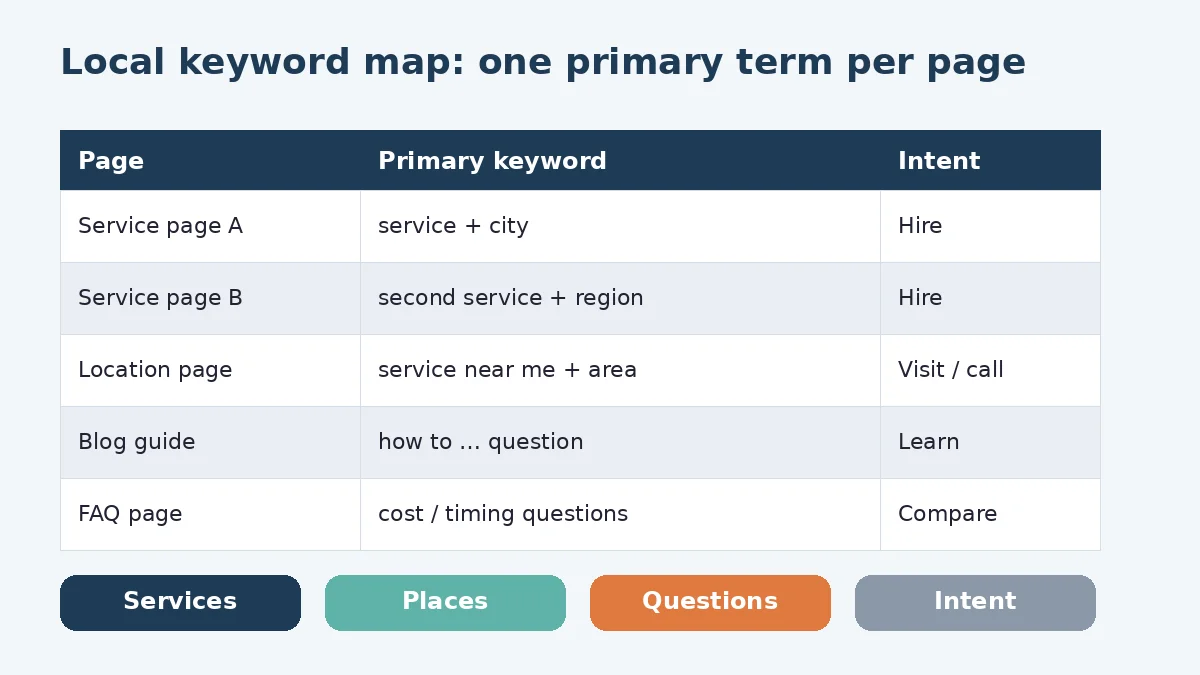
The final step can be a keyword map: a table that can assign each important search term to the one page best suited to it. Each page can get a primary keyword and a few closely related secondary terms.
This can help avoid keyword cannibalisation, where several pages on your site target the same search and end up competing with each other. Google’s guidance on duplicate content explains a related problem: when similar information sits on several pages, people can wonder which is the right one, and search engines pick a single version to show (Google SEO Starter Guide). A map can make overlaps visible before they cause trouble, and show where a new page is needed.
The map can also feed other work. If research shows a page has technical problems holding it back, our technical SEO audit process covers what an audit can check. Content, local SEO and reporting all sit under our SEO and AI search optimization services.
What we won’t do is promise rankings. Keyword research shows where the opportunity is. It can’t guarantee a position, and nobody honestly can.
FAQ
Do I need a separate page for every town I serve?
Not necessarily. A separate page makes sense when you have something genuinely useful to say about that area. Thin pages that only swap the town name can do more harm than good.
Why don’t you give exact search volumes?
Because for local terms they’re estimates, and some can be too low for keyword tools to report. We can rate demand as high, medium or low and check it against your Search Console data over time.
What is keyword cannibalisation?
It’s when several pages on your site target the same search term and compete with each other. A keyword map can give each important term one page to help avoid that.
Working with LaunchLen
We’re LaunchLen Web Solutions Inc., based in Kitchener, serving Waterloo Region and businesses across Ontario.
If you’re not sure which searches your pages should be found for, keyword research is a practical place to start. Tell us about your services and the customers you want more of.
Sources
- Google Search Central, SEO Starter Guide: https://developers.google.com/search/docs/fundamentals/seo-starter-guide
- Google Business Profile Help, Tips to improve your local ranking on Google: https://support.google.com/business/answer/7091?hl=en
- Google Search Central, AI features and your website: https://developers.google.com/search/docs/appearance/ai-features
- Google Ads Help, Use Keyword Planner: https://support.google.com/google-ads/answer/7337243?hl=en
- Search Console Help, Performance report (Search results): https://support.google.com/webmasters/answer/7576553?hl=en

DROP US A LINE
Connect with LaunchLen Web Solutions Inc.
Ready to take the first step towards unlocking opportunities, realizing goals, and embracing innovation? We're here and eager to connect.

To More Inquiry
+1 226 899 4813

To Send Mail